

Anchor rods are fundamental components in structural steel construction, serving as the critical connection between steel superstructures and their concrete or masonry foundations. According to the American Institute of Steel Construction (AISC), anchor rods are defined as mechanical devices that are either cast-in-place or post-installed through drilling and chemical adhesion, grouting, or wedging into concrete and masonry substrates. These components play an essential role in transferring loads from steel columns to foundations while providing stability during erection.
Threading and Nut Requirements
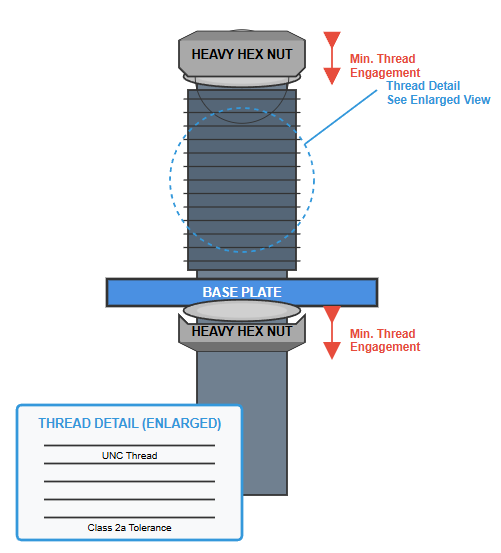
The AISC specifications emphasize the importance of proper threading for anchor rods. While ASTM F1554 permits standard hex nuts, AISC guidelines strongly recommend using heavy hex nuts, particularly for applications involving base plates with large oversized holes. The preferred nut specification is ASTM A563 Grade A, which provides adequate strength and durability for most structural applications.
For anchor rods with cut threads, the nominal stress calculations are based on the unthreaded body diameter. However, for rolled threads, calculations should reference the major thread diameter, which affects the tensile capacity of the connection.
Material Specifications and Standards
The AISC Manual for Structural Steel Construction references ASTM F1554 as the primary material specification for anchor rods. This standard provides three distinct grades of anchor rod material: Grade 36, Grade 55, and Grade 105, each offering different strength characteristics to meet varying structural demands. Unless project specifications indicate otherwise, anchor rods are supplied with unified coarse (UNC) threads featuring a Class 2a tolerance, which ensures compatibility with standard nuts and washers.
It’s important to note that ASTM A325 and A490 bolts, while common in structural steel connections, should not be specified for anchor rod applications. These high-strength bolts include specific head configurations and are designed for different load transfer mechanisms than those required for foundation anchorage.

Anchor Rod Holes and Tolerances
One of the most critical aspects of anchor rod design involves proper hole sizing in base plates. The AISC Steel Construction Manual provides recommended maximum hole sizes for anchor rods, which accommodate reasonable tolerances for construction misalignment while maintaining structural integrity. These oversized holes allow for field adjustment of base plates and columns to achieve proper alignment, which is essential given the inherent variations in concrete work.
The AISC Code of Standard Practice establishes tolerance requirements for anchor rod placement. Section 7.5.1 specifies that installed anchor rods must meet defined positional tolerances. However, designers should recognize that concrete construction tolerances, governed by ACI 117, are generally larger than those for structural steel fabrication. ACI 117 allows tolerances on vertical, lateral, and level alignment of embedded items up to ±1 inch, which can present challenges when interfacing with precision-fabricated steel components.
Design Considerations for Different Load Types
Compression Applications
For the majority of building columns designed primarily for axial compression with minimal uplift, a simple column base plate connection is typically sufficient. In these cases, anchor rods may serve primarily to provide stability during erection rather than resisting permanent structural loads. The AISC Specification addresses bearing strength on concrete, recognizing the increased capacity that results from confinement provided by surrounding concrete.
Tension and Combined Loading
When anchor rods must resist uplift forces or combined axial and bending loads, the design becomes more complex. The AISC Design Guide 1 provides comprehensive guidance on designing anchor rods for tension applications, incorporating recommendations based on American Concrete Institute (ACI) 318 provisions. These provisions address both pullout strength and concrete breakout strength, which are critical failure modes for anchors in tension.
Shear Transfer
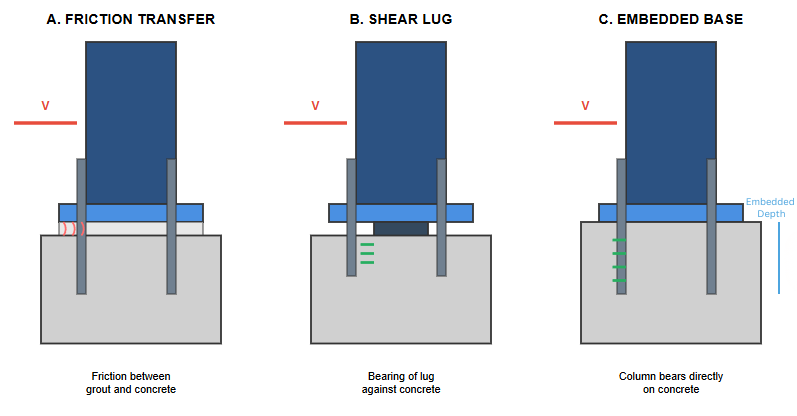
For relatively small shear forces, load transfer can occur through friction between the base plate and grout or through shear friction at the foundation surface. Larger shear forces may require additional mechanisms such as column base embedment, shear lugs, or the use of tie rods and hairpin reinforcing bars to adequately transfer loads from the steel column to the concrete foundation.
Fabrication and Installation Requirements
Base Plate Fabrication
Base plates are typically thermally cut to size, with anchor rod holes either drilled or thermally cut according to AISC Specification Manual. The specification includes requirements for thermal cutting quality, stipulating that gouges deeper than a specified dimension and any notches must be removed or repaired. Most fabricators prefer to shop-weld base plates to columns whenever possible, though field considerations may sometimes necessitate field welding.
Setting and Grouting
The AISC specifications recommend that anchor rod layout and post-placement surveying be performed by experienced construction surveyors who can read structural drawings and understand construction practices. Setting plates, typically four inches thick and slightly larger than the final base plate, are sometimes used as temporary alignment aids during concrete placement. After the concrete cures and anchor rods are verified, these setting plates are removed.
Grout holes in base plates are not always required. For plates 24 inches or less in width, forms can be established, and grout can be pumped from one side. Larger plates typically require grout holes to ensure complete filling beneath the base plate.
Erection Stability and Safety
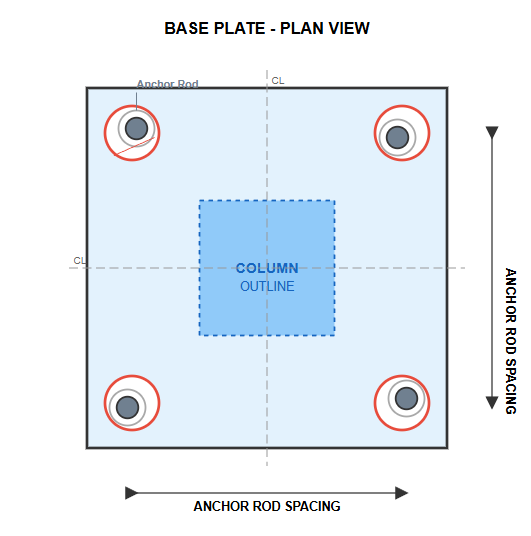
OSHA regulations require that column bases include a minimum of four anchor rods to provide initial erection stability. Additionally, foundations, base plates, and anchor rods must be designed to withstand the eccentricity of a 300-pound vertical load located 18 inches horizontally from the column face. However, as a general guideline, many practitioners recommend designing column bases to resist 10 to 15 psf wind loads applied to the column face, as this typically results in larger and more realistic overturning moments than the minimum OSHA requirements.
Common Field Issues and Solutions
Despite careful planning, anchor rod installations frequently encounter field issues. Common problems include rods being too long, too short, out of position, bent, or damaged during construction. The AISC literature provides various field correction methods, including the use of plate washers for oversized conditions, coupling nuts for extensions, and hot or cold bending techniques for repositioning (within material temperature limits).
Prevention remains the best approach to avoiding field problems. This includes specifying appropriate tolerances in contract documents, hiring qualified surveyors for anchor rod layout, protecting installed rods during subsequent construction activities, and maintaining clear communication between design professionals, concrete contractors, and steel erectors.
Integration with Project Documentation
The AISC Code of Standard Practice emphasizes the importance of clear communication through shop drawings, erection drawings, and embedment drawings. These approval documents must clearly indicate anchor rod locations, sizes, grades, projection heights, and any special requirements. Coordination between structural steel shop drawings and concrete contractor placement drawings is essential to avoid conflicts and ensure successful installation.
Anchor rods represent a critical interface between concrete and steel construction, requiring careful attention to material specifications, dimensional tolerances, design loads, and installation procedures. By following AISC standards as outlined in the Manual for Structural Steel Construction, the Specification for Structural Steel Buildings, and related design guides, engineers and contractors can create reliable, constructible connections that provide long-term structural performance. Understanding these requirements helps avoid common pitfalls and ensures that steel structures are safely and efficiently anchored to their foundations.